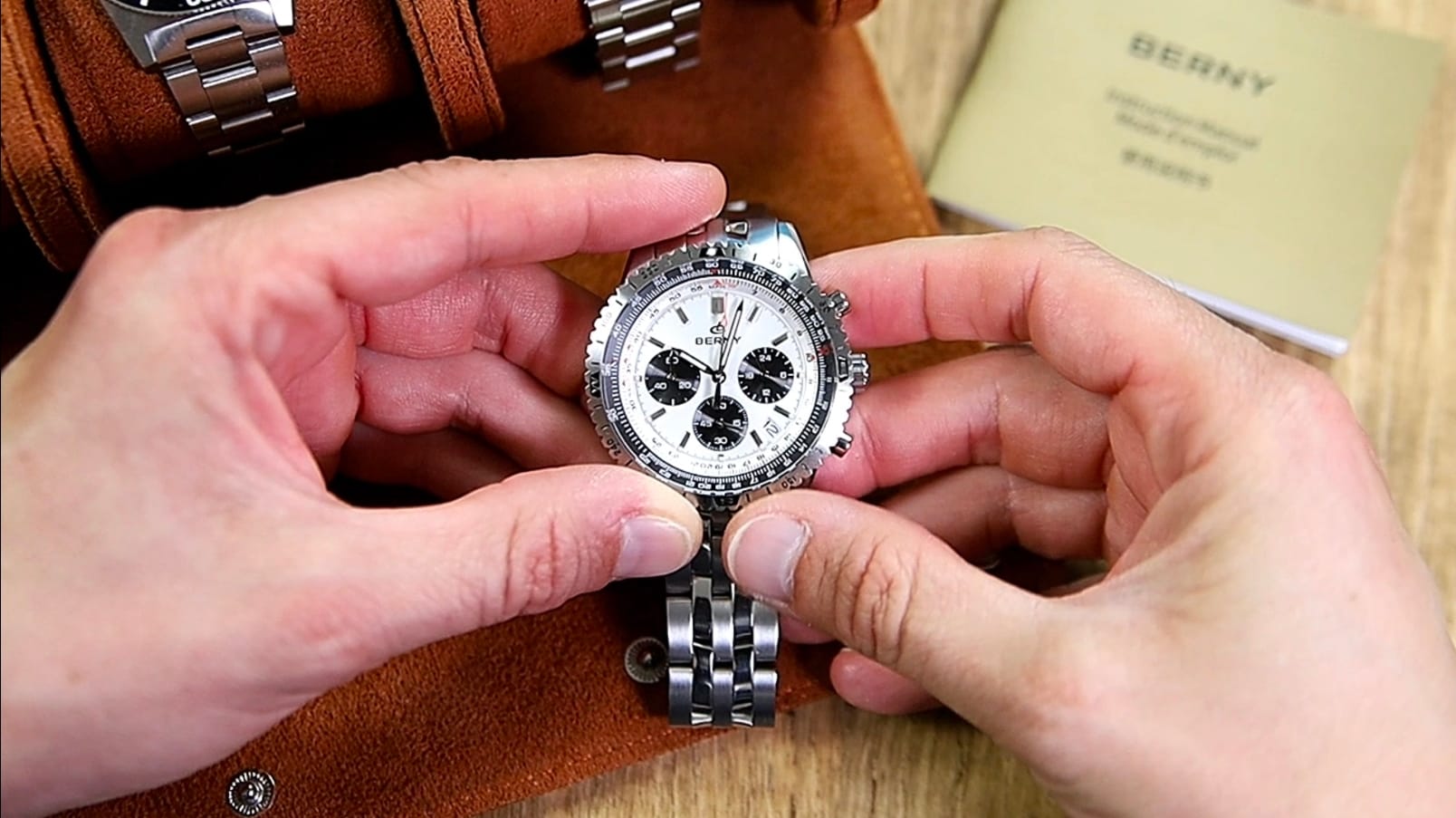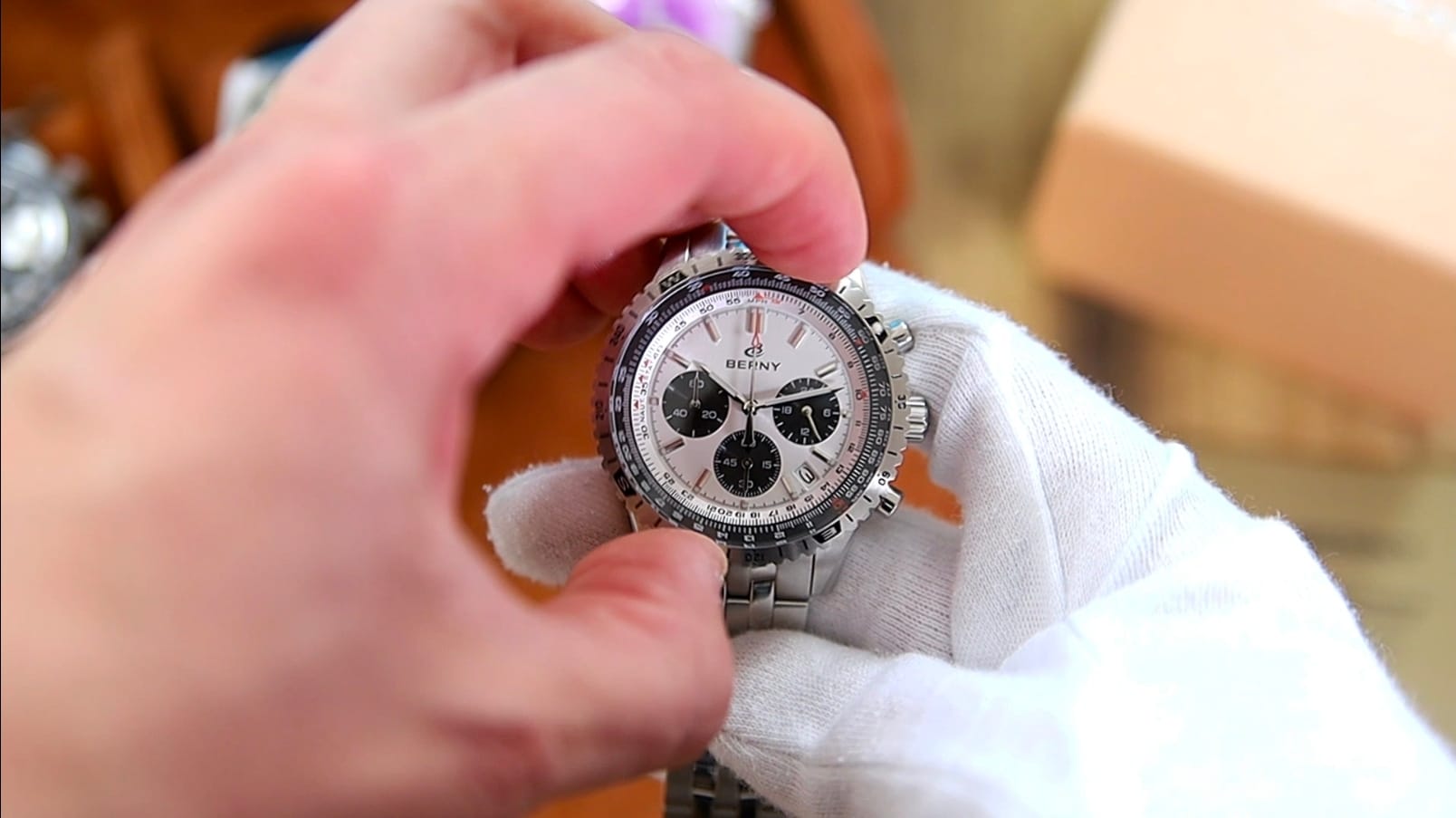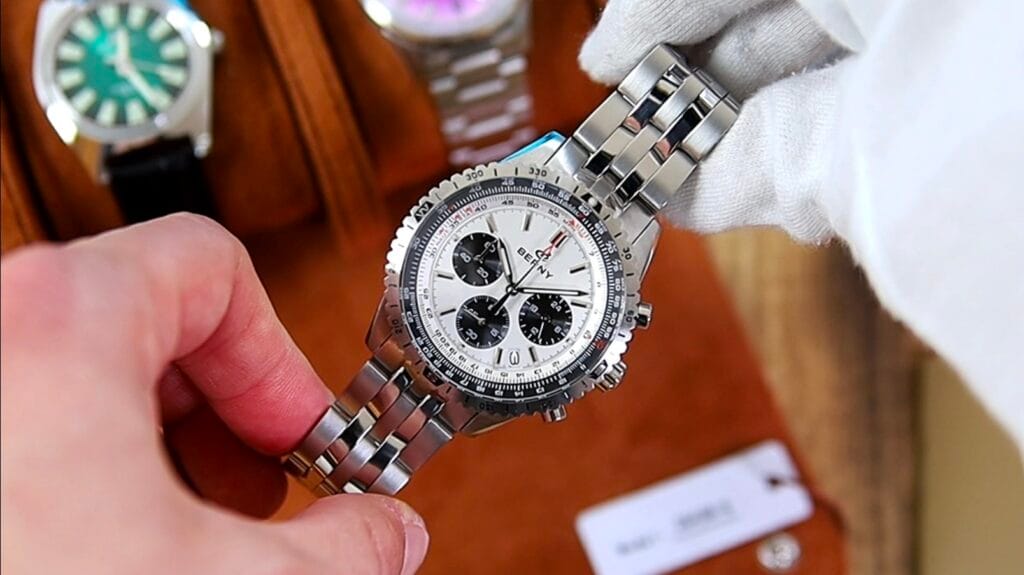
Some watches feel ambitious. Others feel complicated. The Berny 2845M feels almost defiant. From the moment it’s on the wrist, this pilot chronograph announces itself as one of the most complex homages available on AliExpress—and arguably anywhere near its price bracket. With a fully functional slide-rule bezel, dense stainless-steel construction, and a hybrid mecha-quartz chronograph movement, this is not a watch designed to fade quietly into a collection.
At around $85 before tax, the specifications alone seem implausible. But complexity always comes at a cost, and this watch wears its trade-offs openly. On paper, it looks extraordinary. In hand, it largely delivers—but with a few quirks that need honest discussion. This is not a novelty piece, nor is it a fashion-first chronograph. It’s unapologetically tool-forward, heavy, visually dense, and engineered around function first. The question isn’t whether Berny aimed high—they clearly did—but whether the execution justifies the ambition. Did you read our other Berny Watch reviews?


Design & Case
The 2845M makes its intentions clear through sheer physical presence. The case measures 41.8 mm in diameter, with a sub-51 mm lug-to-lug length, and an all-steel construction that weighs approximately 150 grams before sizing. Despite that figure, the watch feels even denser in hand—an overbuilt, almost industrial sensation that reinforces its cockpit-instrument identity.
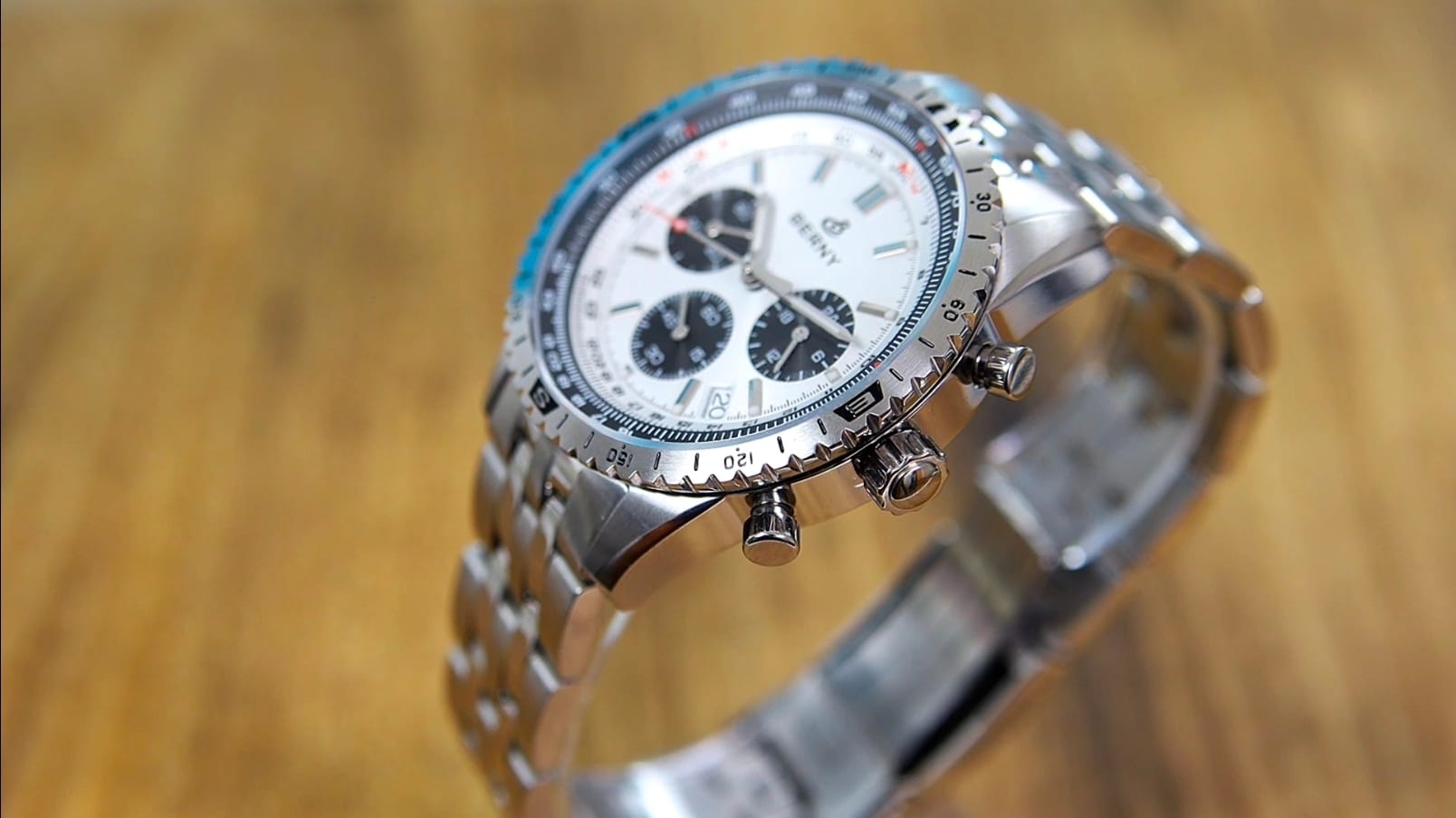
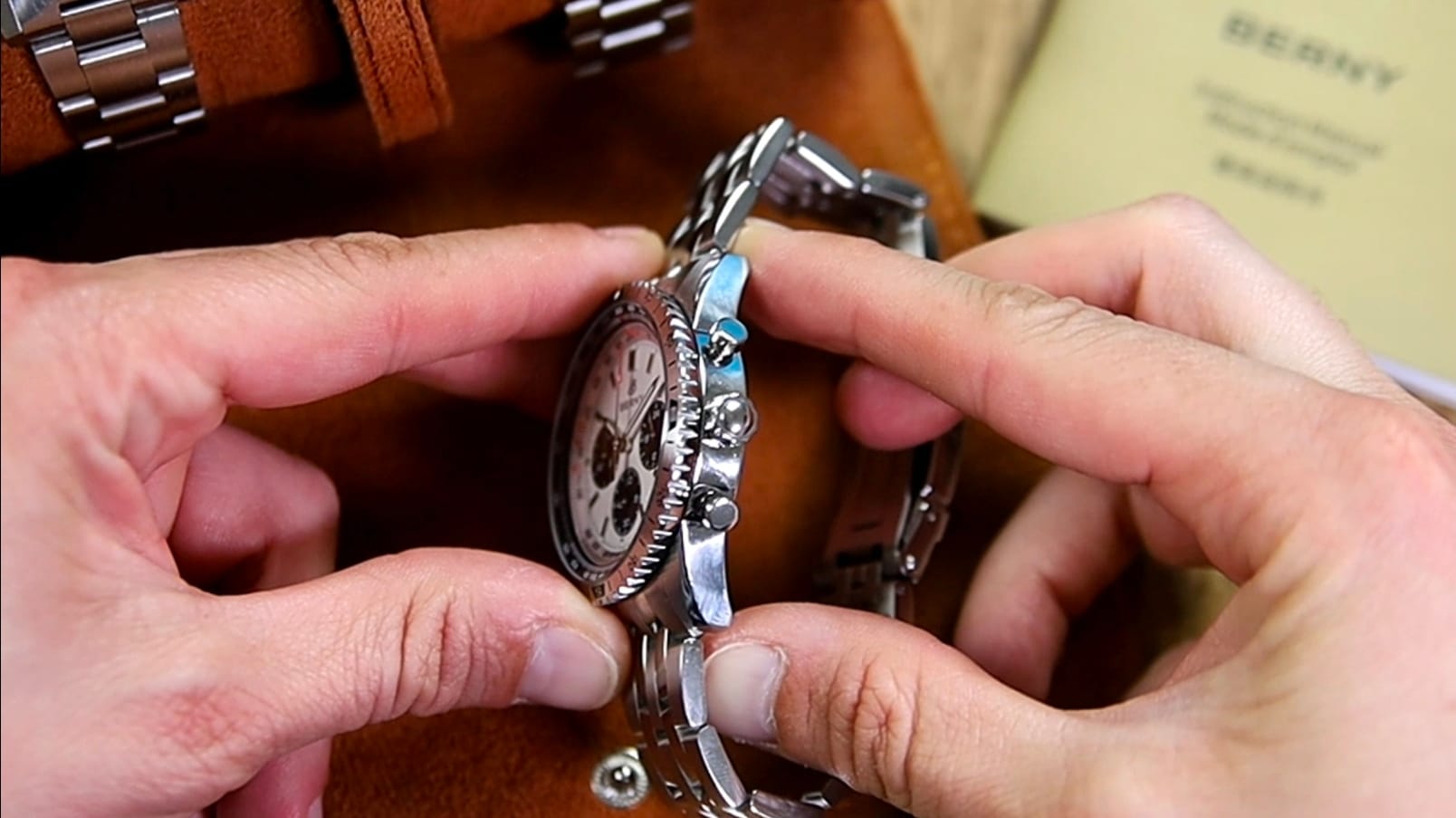
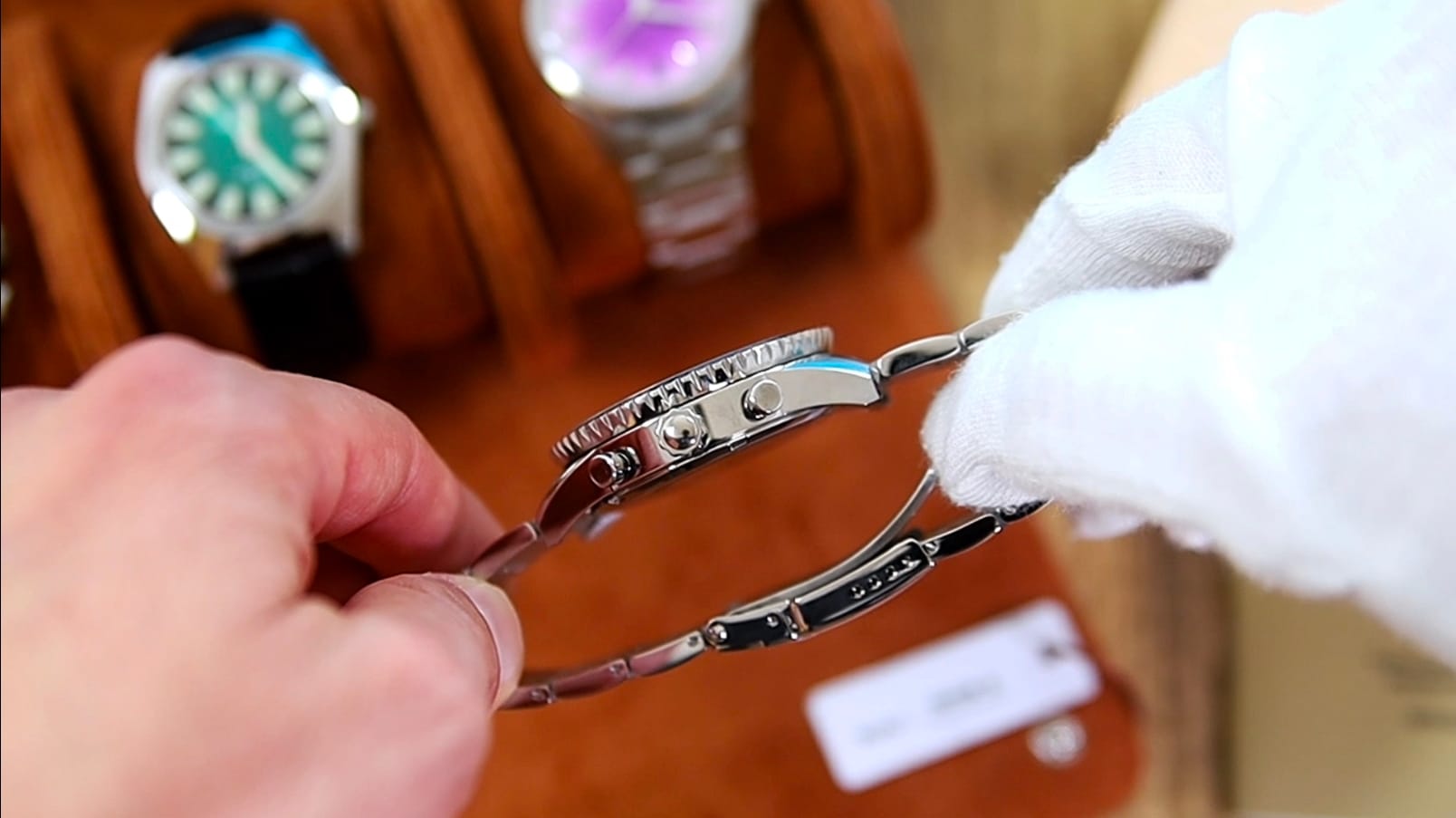
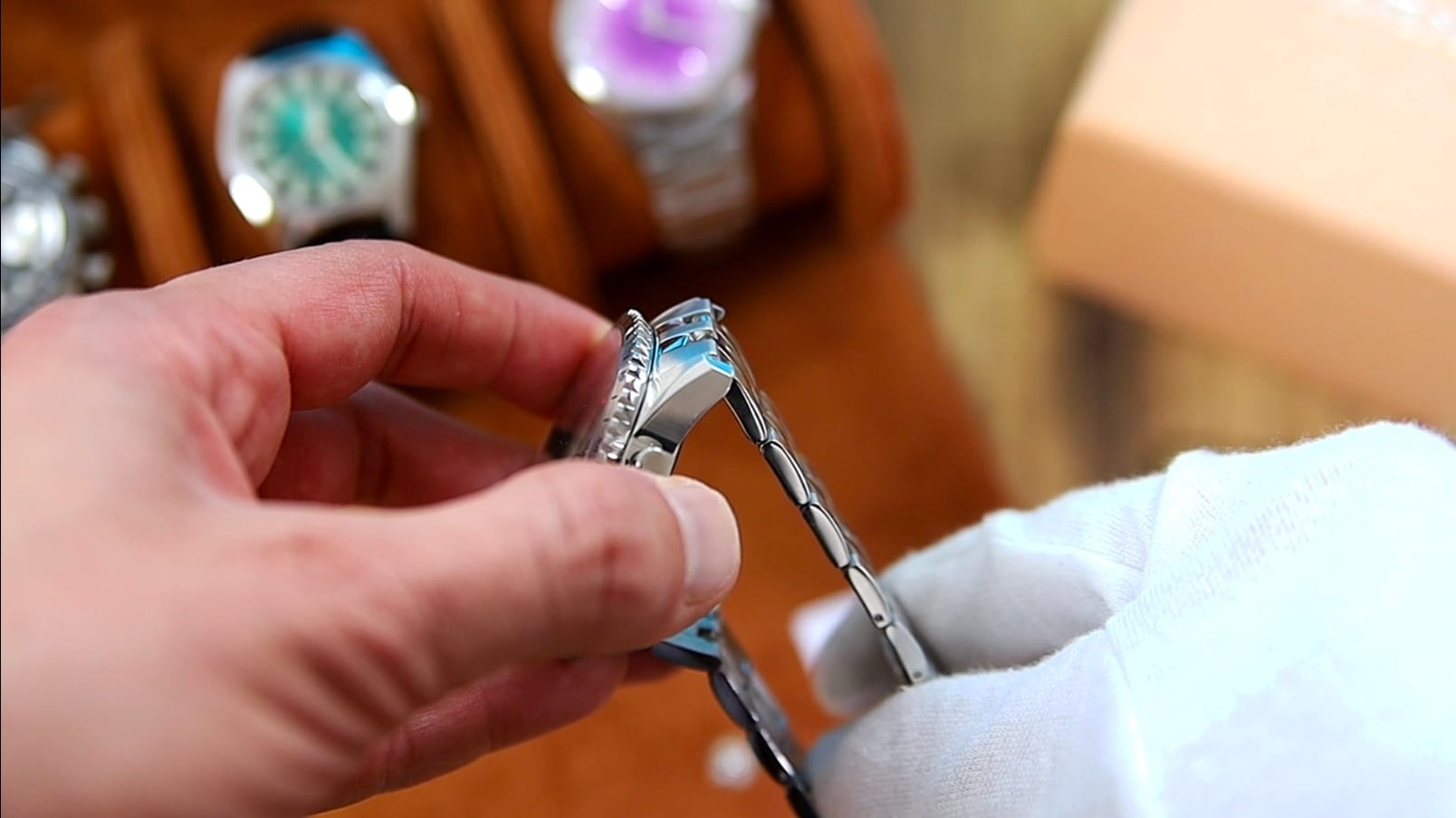
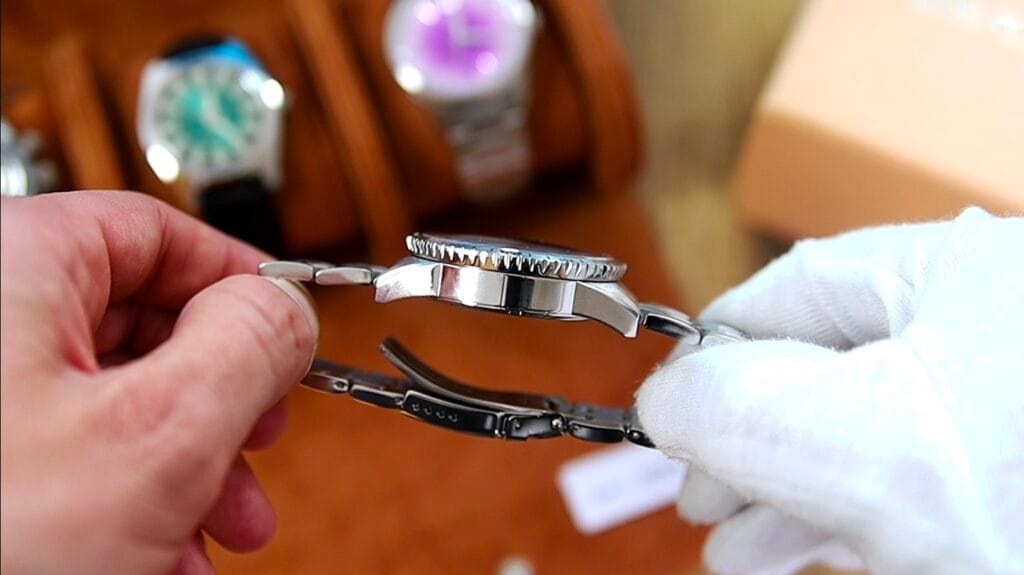
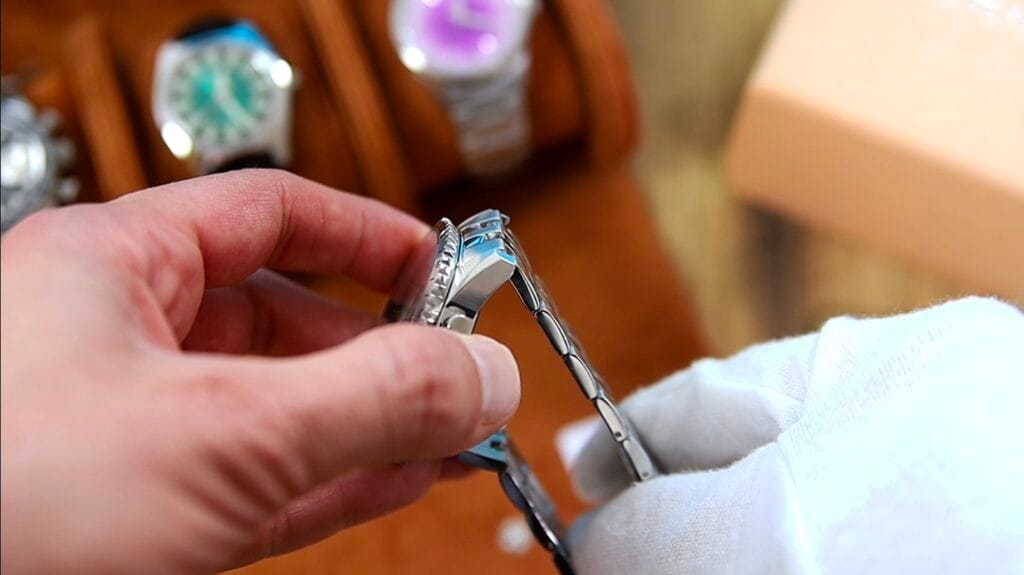
From the side, the case is a study in contrast. The mid-case flanks are mirror polished and slightly slab-sided, but the transitions are thoughtfully handled. A 45-degree polished bevel arcs outward as it approaches the lugs, flaring subtly to add visual width. That bevel acts like a light scoop, bouncing reflections into the sharply brushed lug hoods, creating tension between polish and matte finishes. It’s not delicate, but it is deliberate.
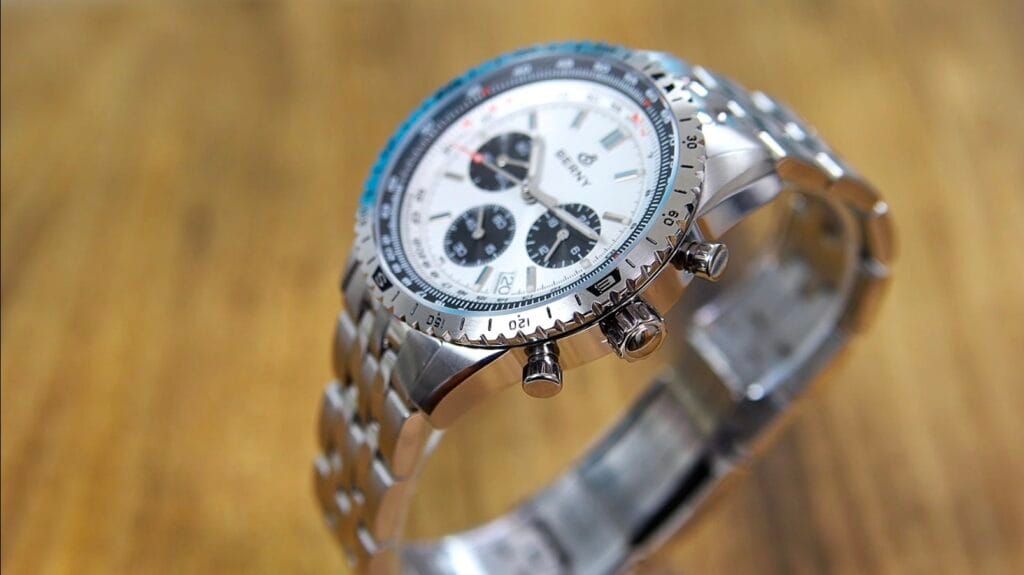
At three o’clock sits a 6.1 mm push-pull crown, flanked by tall, assertive chronograph pushers. Both crown and pushers are unsigned and finished in the same high-polish mirror surface. They resemble piston-style pushers visually, though without exposed collars or telescoping travel, suggesting a fixed plunger construction. Regardless, they’re tactile, prominent, and visually coherent with the case design.
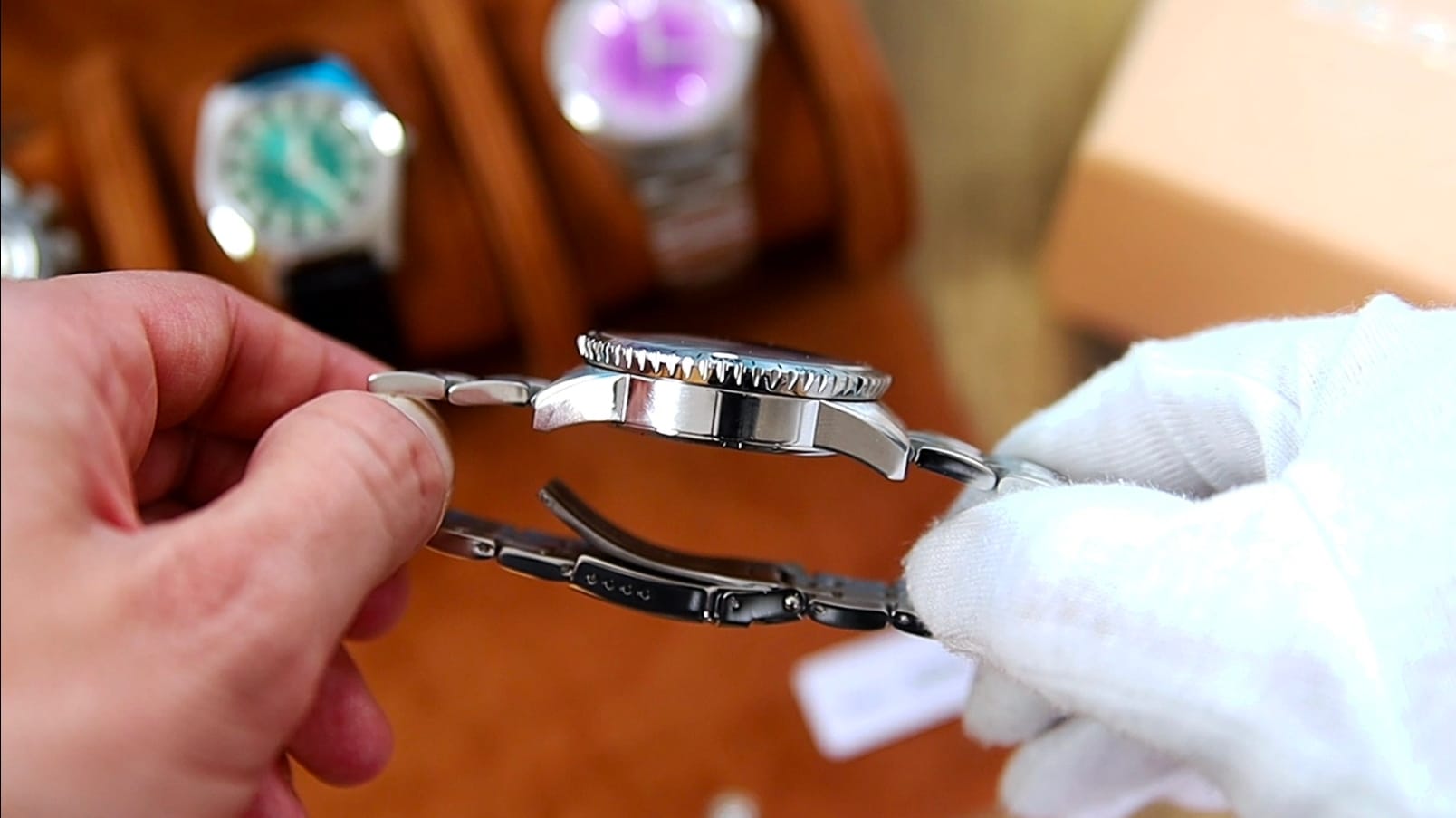
Despite its mass, the watch wears more compactly than expected thanks to inward-sloping inverted end links, which help keep the effective lug-to-lug length under control on a midsize wrist. This is a bold case, but one that feels intentional rather than clumsy.
You may want to see another exciting pilot watch homage – the Hruodland Turbine.
Movement & Crown
Powering the Berny 2845M is the Seiko VK63 meca-quartz chronograph movement, made in Japan. This hybrid caliber combines quartz regulation for timekeeping with a mechanical chronograph module, delivering a distinctly tactile experience. Pushers engage cleanly, the chronograph seconds hand starts without stutter, and reset snaps crisply back to zero—hallmarks of this movement architecture.
Battery life is rated at approximately three years, with expected accuracy within ±20 seconds per month. This ensures dependable daily performance without the servicing demands of a fully mechanical chronograph. In use, the movement strikes a practical balance: mechanical feel where it matters, quartz reliability where it counts.
The 6.1 mm push-pull crown operates smoothly, with a solid, confidence-inspiring feel. While not screw-down, it integrates neatly into the case profile and matches the polished pushers visually. Chronograph pushers are tall and easy to locate, offering clear tactile feedback when starting, stopping, and resetting the timer.
Functionally, the VK63 supports the watch’s tool-watch ambitions well. It allows the dial and slide-rule bezel to remain highly legible and functional without the added complexity, thickness, or fragility of a fully mechanical chronograph caliber.


Bezel
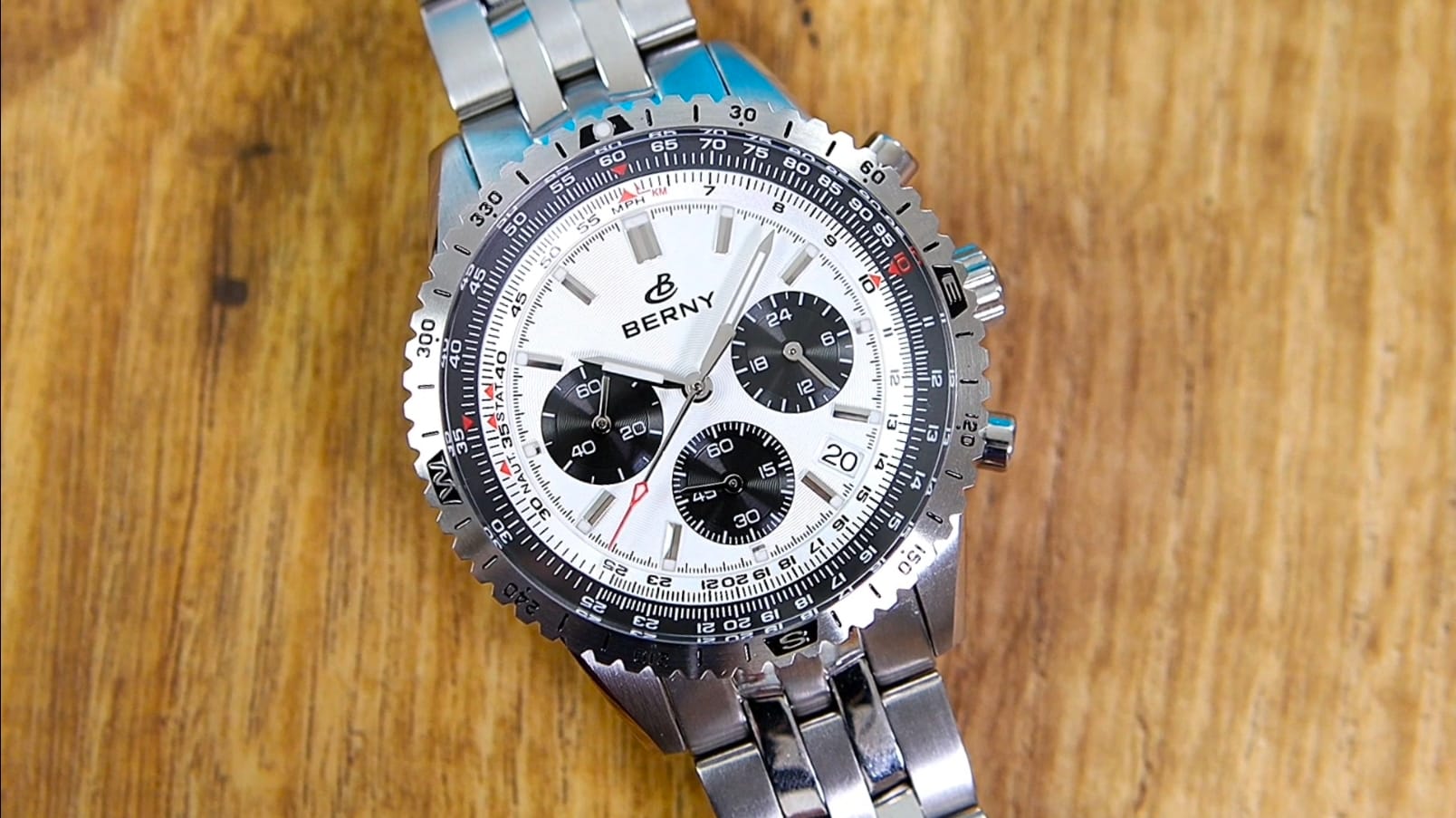
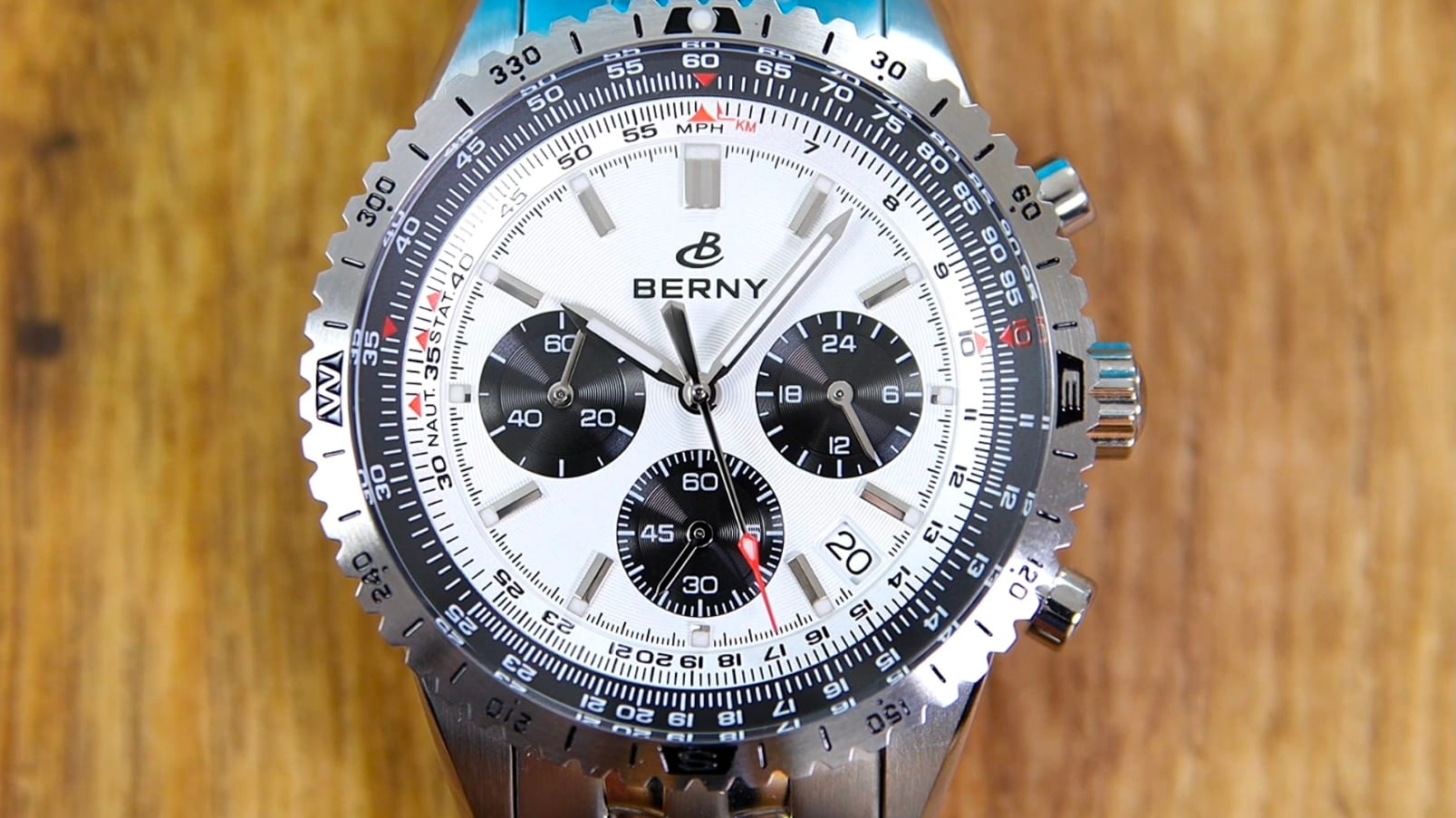
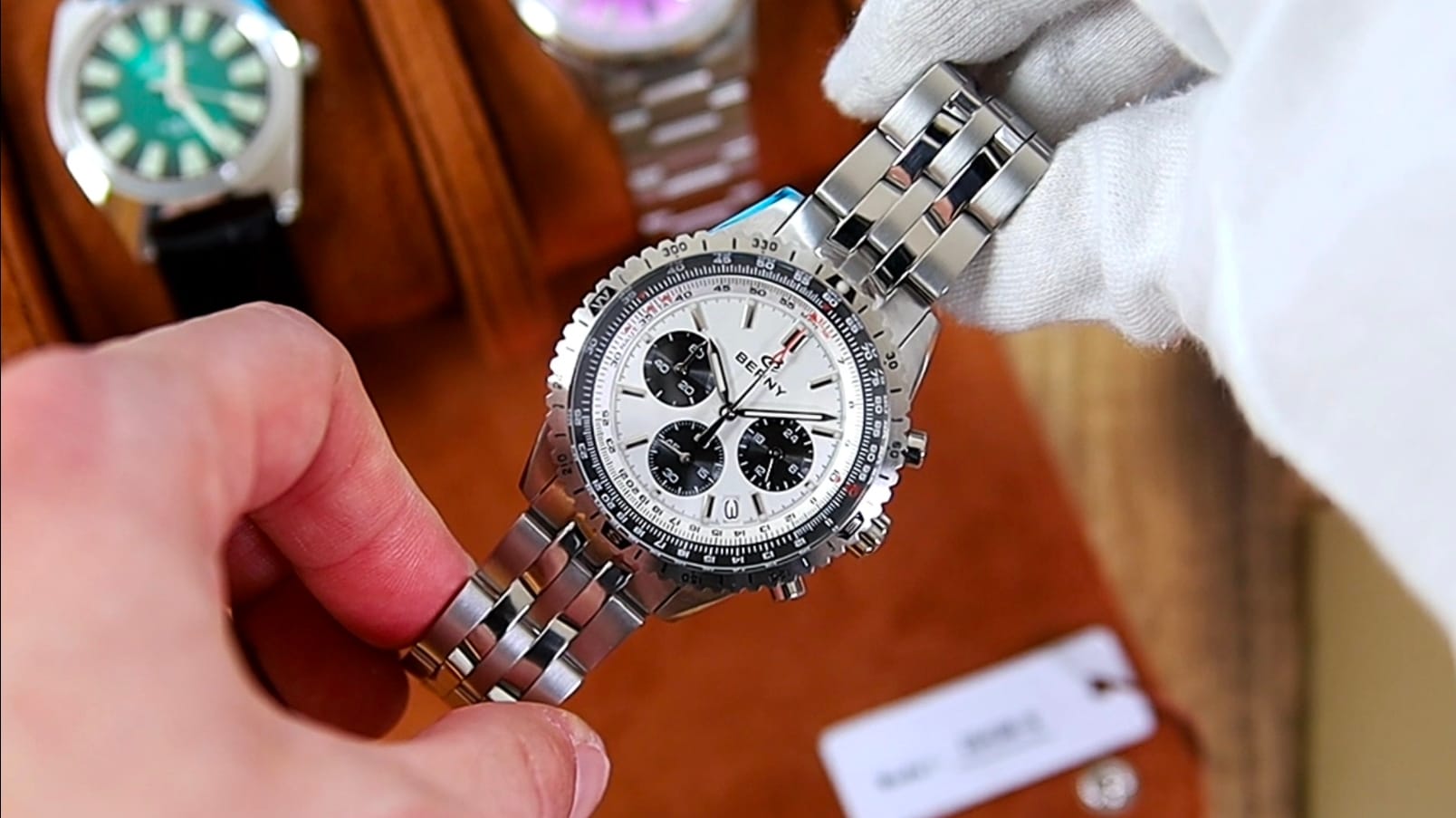
The bezel is the defining feature of the Berny 2845M—and arguably its soul. This is not a decorative ring, but a fully functional bidirectional slide-rule bezel, turning the watch into a mechanical calculator. It allows conversions between nautical miles, kilometers, and statute miles, as well as calculations for fuel burn, ground speed, and rate-time-distance—direct descendants of mid-century aviation tools.
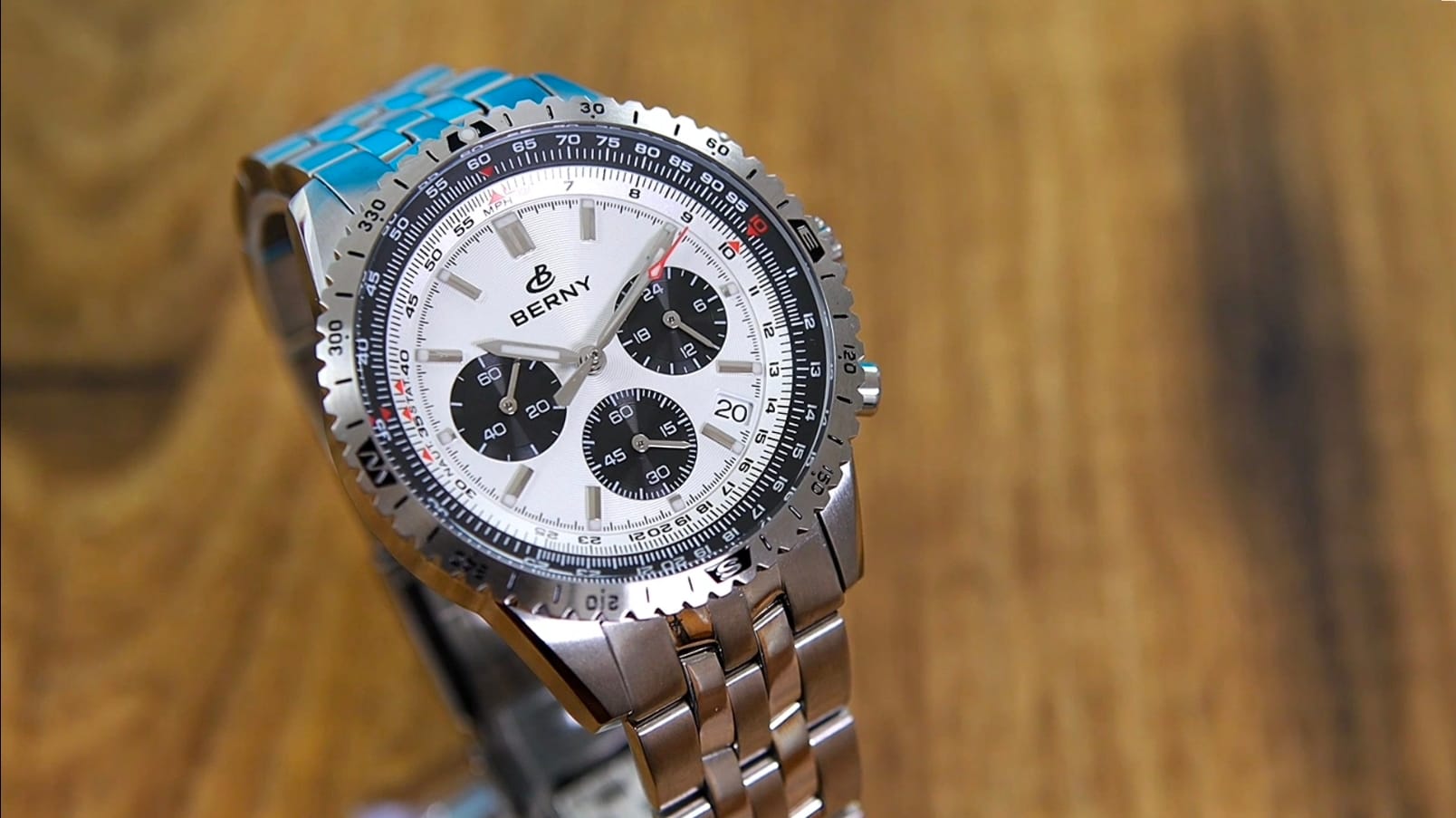
Physically, the bezel is fully stainless steel and multi-textured. The outer edge features deeply notched polished cutouts, acting as pseudo-scallops that provide excellent grip and dramatic light play. The top surface is brushed steel, engraved with high-precision markings, including compass points, flight-centric scales, and layered logarithmic rings. Alignment is crisp and visually dense, reinforcing the watch’s cockpit-instrument identity. We’ve seen bi-directional bezels across other pilot-style watches, like the San Martin SN0127.

In operation, the bezel is fully bidirectional with no clicks. Rotation is smooth, fluid, and evenly damped—described best as buttery but controlled. This continuous sweep is essential for slide-rule functionality, allowing precise alignment rather than indexed steps. There’s no wobble, no float, and resistance feels well tuned.
That said, realism matters. Without detents or unidirectional protection, the bezel can be knocked out of alignment if struck. Combined with its noticeable overhang beyond the mid-case, long-term durability of the friction system remains an open question. For now, though, the tactile experience is excellent and integral to the watch’s identity.
Bracelet
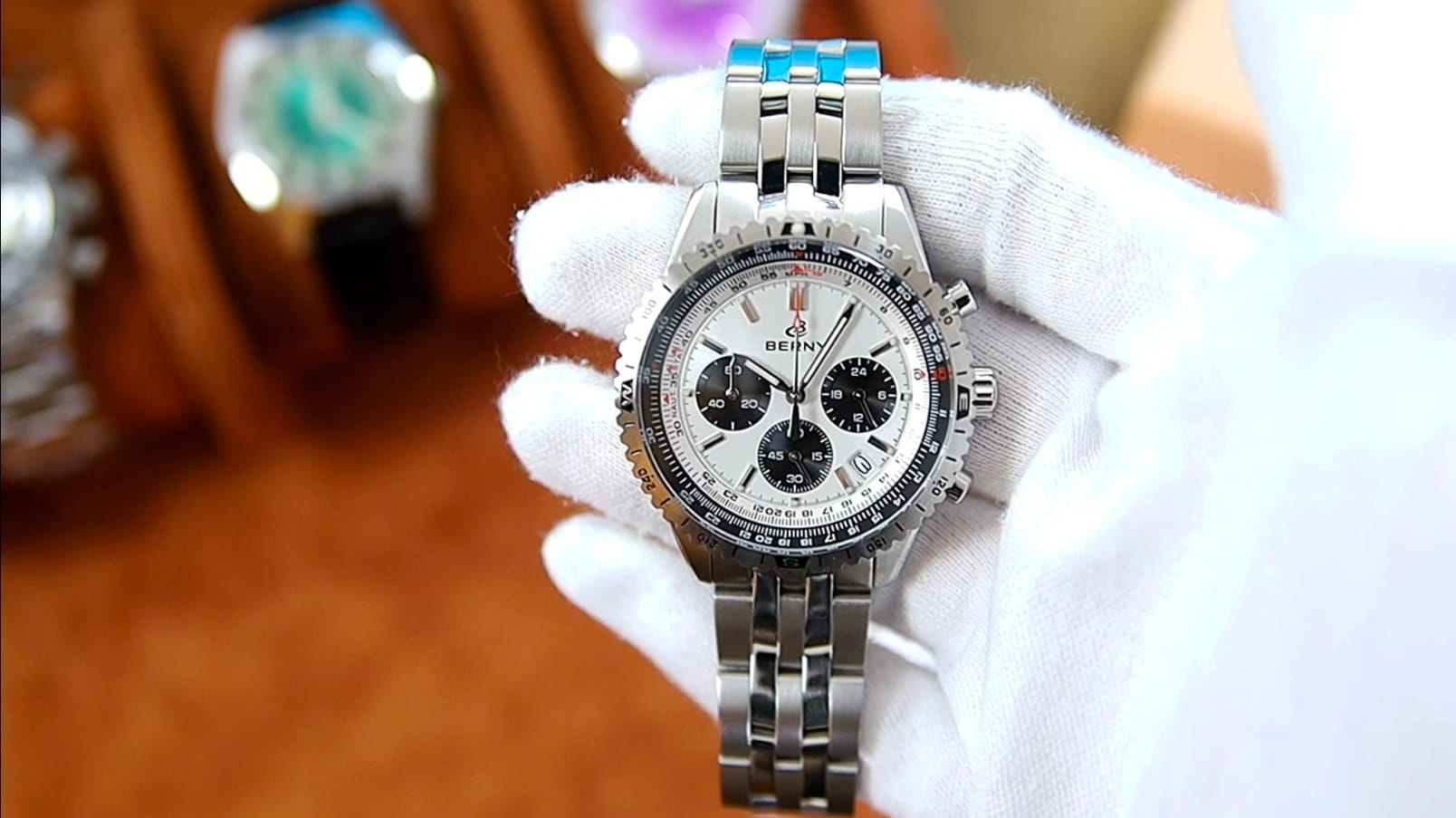
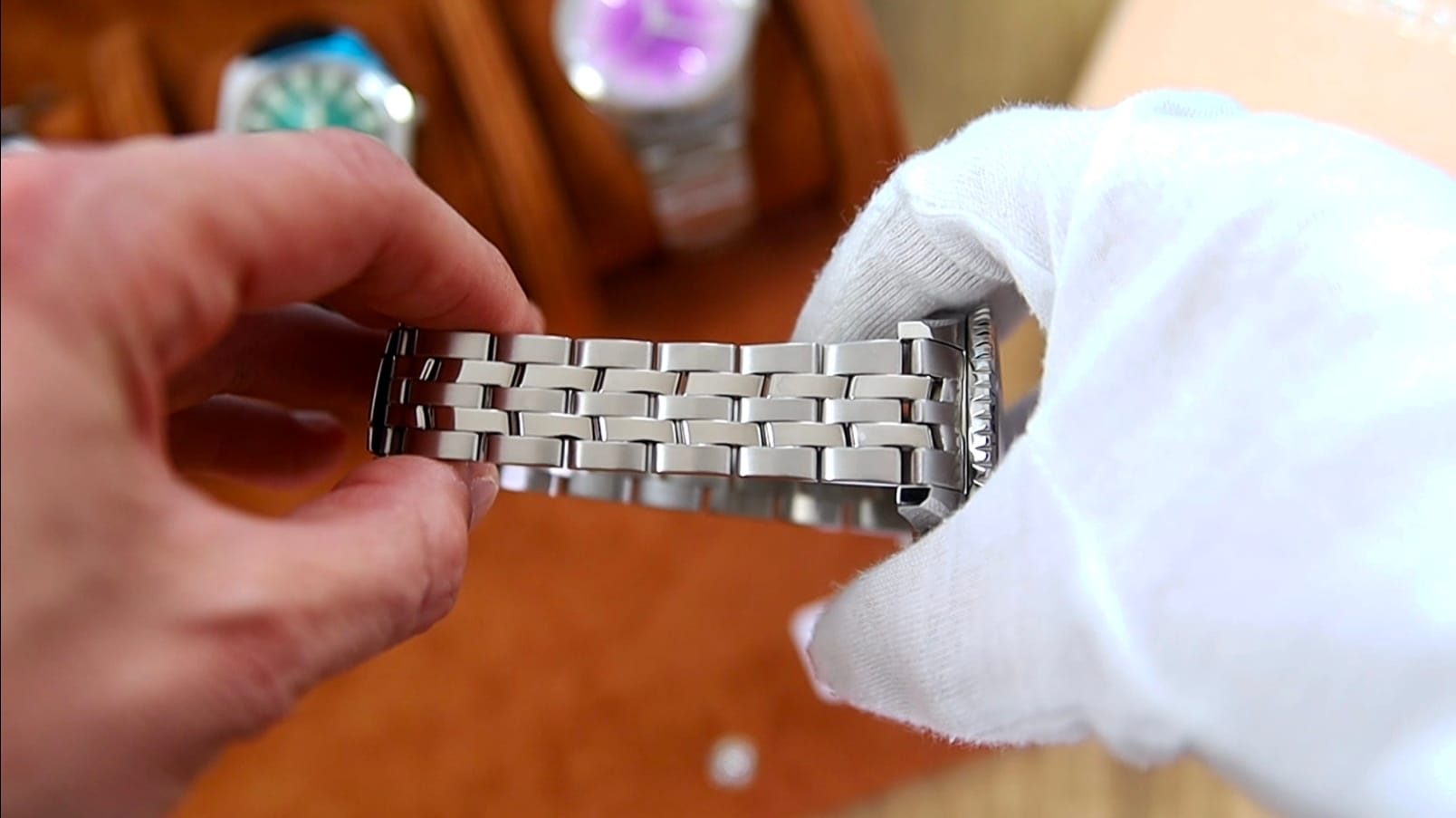
The bracelet is as unconventional as the watch itself. It’s a five-link stainless-steel design, but geometry is where it truly stands apart. The central three rows form a zig-zag, almost fishbone pattern, with diagonally faceted inner links finished in polish. This creates a dynamic interplay of light as the wrist moves, adding visual complexity without drifting into flashiness.
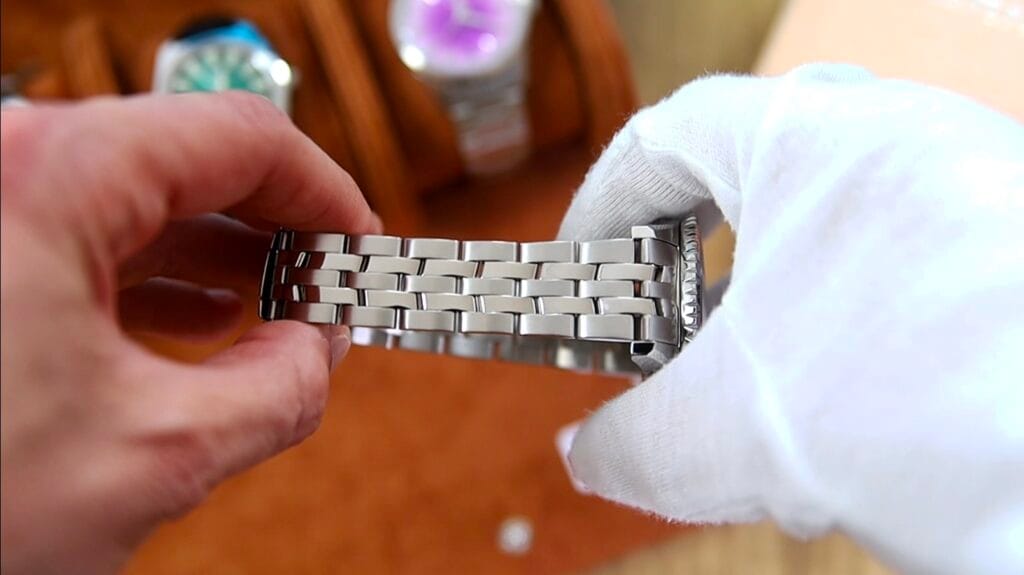
The outermost flanks of the bracelet are polished, while the main surfaces are brushed. There is a slight tonal mismatch between the bracelet brushing and the lug hoods—likely due to grit or direction differences—but it’s subtle rather than distracting. Importantly, the inverted end links prevent the bracelet from extending the effective lug-to-lug length, helping maintain wearability.
Construction uses push pins rather than screws, but tolerances are impressively tight. There’s very little rattle, and articulation is good. The bracelet drapes naturally, reminiscent of a beads-of-rice feel but with more structure and mass.
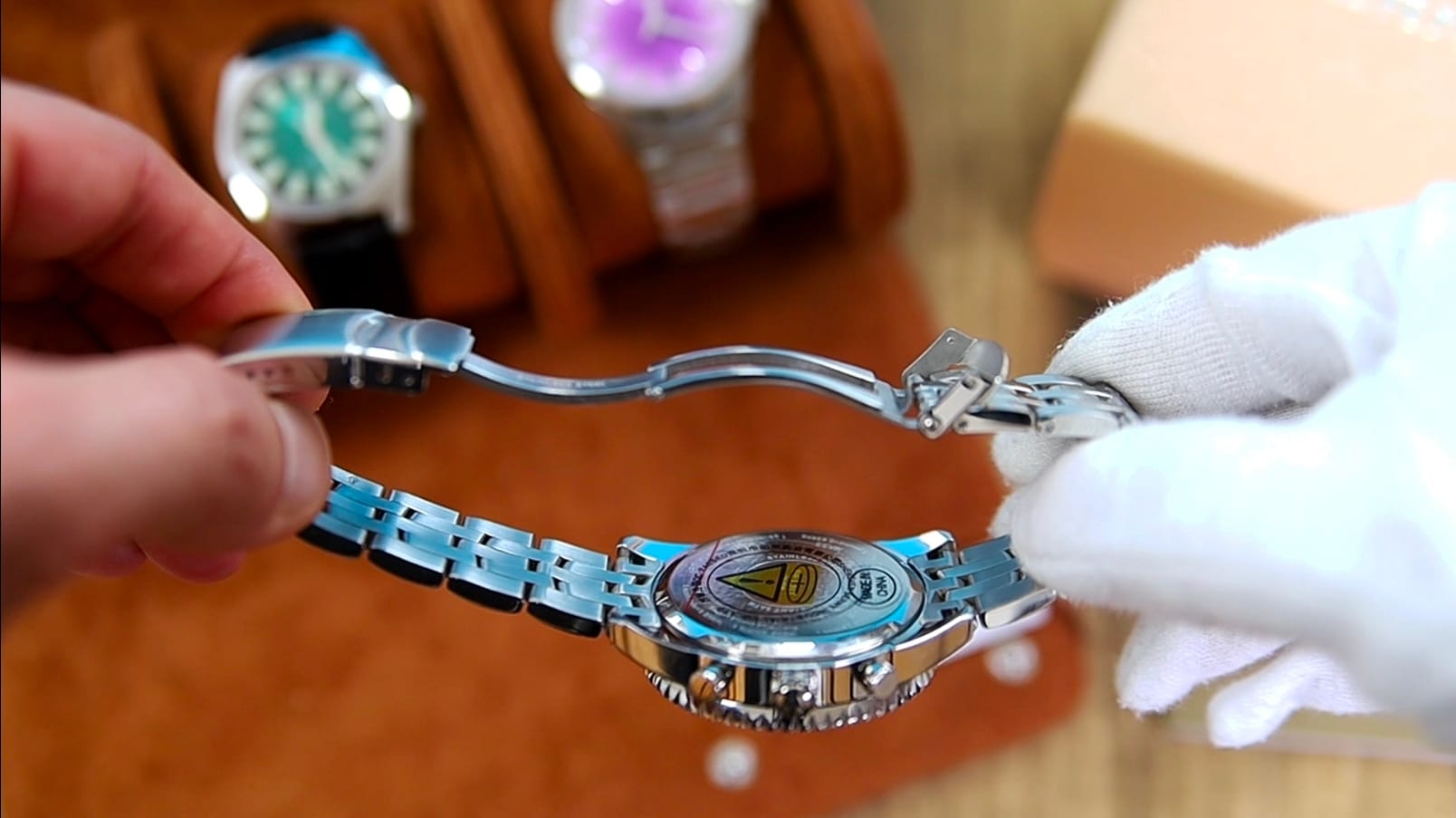
The clasp is a standard fold-over design with safety lock, unsigned but functional. Inside, there’s a milled folding wing, which is notable at this price point. Four micro-adjustment positions provide sufficient granularity for proper fit without half links. Overall, the bracelet feels refined, dense, and thoughtfully executed.
Crystal & Dial
The watch is topped with a slightly domed synthetic sapphire crystal, sitting just above the bezel. The dome is subtle rather than dramatic, but it softens reflections and adds a gentle roll-off at the edges. Crucially, the crystal is anti-reflective coated, producing a faint violet hue at certain angles—an important feature given the dial’s visual density.
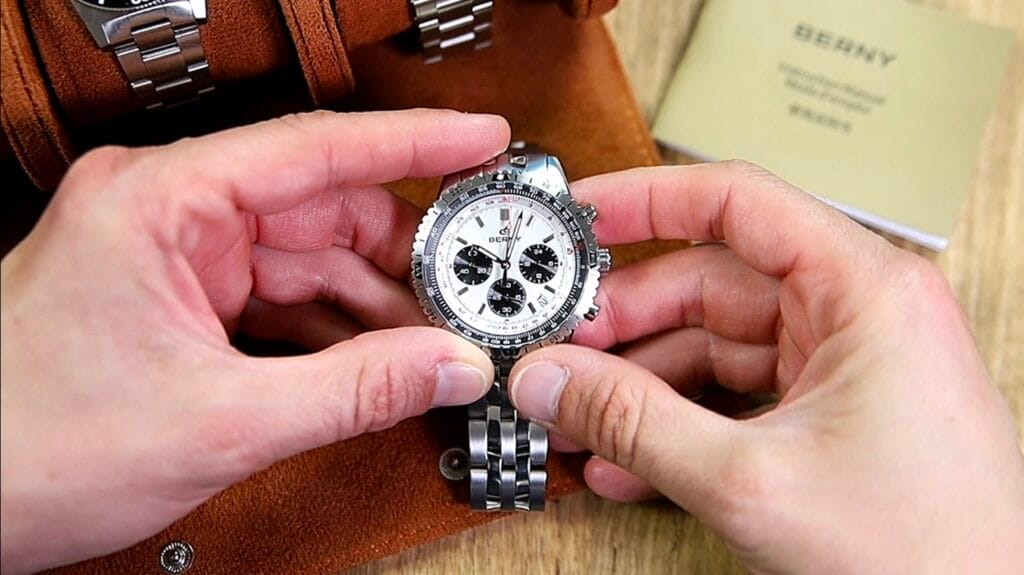
Beneath the crystal lies a complex, multi-layered instrument panel rather than a simple dial. The outermost ring is the steel slide-rule bezel. Inside that, the first inner ring is black with fine white calibrations and red markings at 10, 20, and 35, historically used for converting miles, kilometers, and nautical miles. Next comes a wide, sloped rehaut carrying crisp black numerals and another red reference point for miles-per-hour calculations. These elements are functional, not decorative.
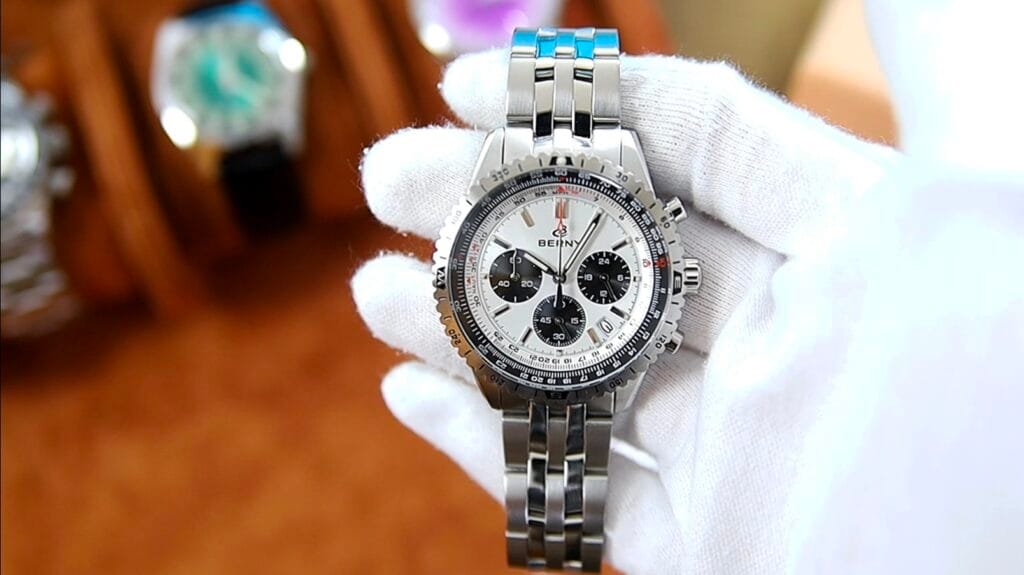
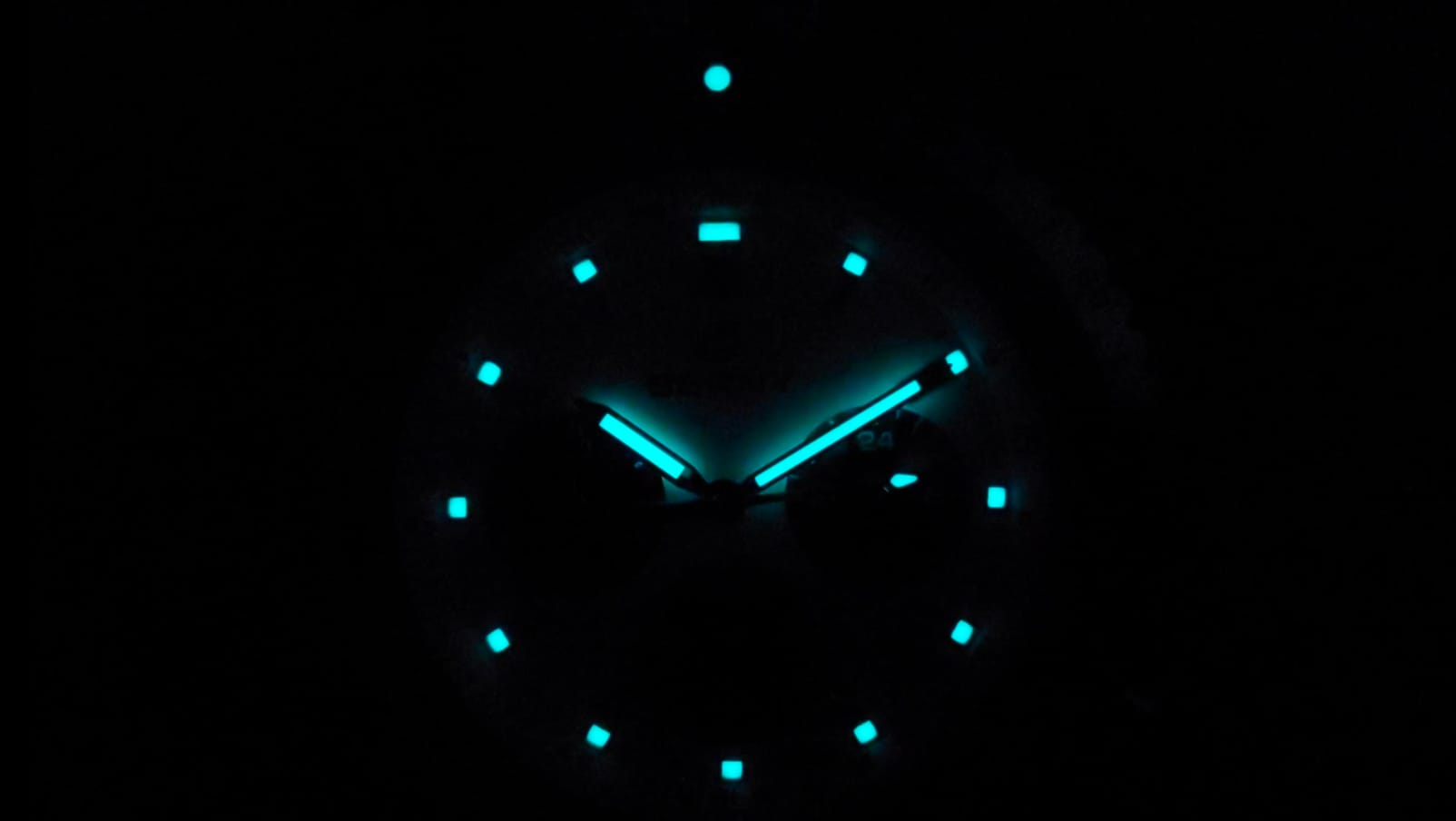
The dial itself is white with a subtle radial texture, more restrained than a traditional sunburst. Applied chrome baton indices sit above small lume plots tucked at the edge of the rehaut. The hands are lume-filled for hours and minutes, while the three black sub-dials feature fine sunburst finishing. Their polished chrome hands look excellent in direct light, though contrast drops at lower angles—one of the dial’s weaker points.
A date window adds practicality but sits slightly closer to five than four—noticeable once seen, though neatly beveled. Overall, it’s a dense but purposeful layout, rooted firmly in aviation heritage.
Summary
The Berny 2845M is a study in ambition. It delivers a functional slide-rule bezel, a dense stainless-steel case, a visually intricate dial, and a tactile meca-quartz chronograph movement—all for under $100 before tax. That alone makes it remarkable.
Yes, shortcuts exist. Legibility in the sub-dials isn’t perfect, the date placement will bother some, and the long-term durability of the friction-based slide-rule bezel remains to be seen. But these compromises feel measured rather than careless.
What Berny has created here is not just a homage, but a fully realized tool watch that invites interaction. It’s heavy, complex, unapologetically functional, and visually commanding. For enthusiasts who appreciate aviation history and mechanical problem-solving on the wrist, the 2845M offers something genuinely rare at this price point: substance backed by serious intent. Explore our other pilot watch reviews HERE.
Berny 2854M Pilot Chronograph Specifications
| Specification | Details |
|---|---|
| Model | Berny 2845M |
| Case Diameter | 41.8 mm |
| Lug-to-Lug | Sub-51 mm |
| Case Material | Stainless steel |
| Case Finish | Polished flanks, brushed lug hoods |
| Weight | ~150 g (before sizing) |
| Crown | 6.1 mm push-pull |
| Pushers | Tall, polished, unsigned |
| Bezel | Stainless steel bi-directional (floating bezel) slide-rule |
| Crystal | Synthetic sapphire with AR |
| Movement | Seiko VK63 meca-quartz |
| Dial | White |
| Sub-Dials | Three, black, sunburst |
| Bracelet/Strap | Stainless steel, five-link. Bracelet Construction: Push pins |
| Clasp | Fold-over with safety lock. Micro-Adjust: 4 positions |
| Approx. Price | $85 before tax |