The Affordable Automatic Watch Movements Buying Guide
Automatic watches are where budget watch enthusiasm usually starts to get interesting. In the affordable space, automatics aren’t about prestige or in-house bragging rights — they’re about trade-offs: durability, consistency, winding efficiency, and how forgiving a movement is when you wear it like a normal person. Essentially we’re choosing between a handful of movement families that show up again and again, each with their own personality in daily wear.
Below is the budget-to-premium ladder I actually use when I’m thinking about ownership, not just price.
Ultra-budget automatics: Pearl / DG (the “it works… mostly” tier)
The Pearl/DG family (DG2813 and relatives) sits at the entry point of automatic ownership for a lot of people, often without them even realising what’s inside. These movements are cheap, widely available, and built to hit a cost target. The basic architecture is simple and familiar: automatic winding, basic regulation, day/date variants depending on the model.
What’s important is not the idea of the movement — it’s the consistency. In this tier, the movement can be surprisingly OK when it’s assembled and lubricated well, and frustrating when it isn’t. You’ll see wider variation between examples than you do with NH or Miyota. That’s the reality of this segment.
Typical profile you’ll see quoted:
- Beat rate: commonly 21,600 bph
- Jewels: often low-20s
- Power reserve: mid-30 hours-ish
- Accuracy expectation: can be all over the place; treat it as “budget mechanical reality,” not a promise
In daily wear, the “DG experience” is usually fine if you wear the watch consistently and don’t expect it to behave like a regulated, mature movement family. It’s the kind of automatic that teaches you what mechanical ownership feels like — including the compromises.
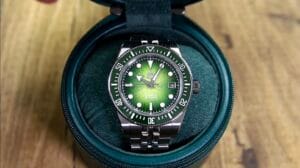
Seagull automatics and hand-wounds: more variety than people assume
Seagull is where you stop talking about one movement and start talking about a portfolio. This is also where enthusiasts get sloppy — they’ll say “Seagull” as if it’s one thing. It isn’t.
Seagull ST16 (budget automatic, solid baseline)
This is a common “step up” movement because it tends to be more consistent than the very bottom tier while still remaining affordable.
Commonly cited profile:
- 21,600 bph
- ~21 jewels
- ~36 hours power reserve
- Often hand-windable, often hacking depending on variant
In daily wear, ST16 watches tend to feel like honest budget automatics: simple setting, stable running, not ultra-refined, but workable.
Seagull ST17 (small seconds family)
ST17 is often used when a brand wants small seconds at 6, or a more vintage-inspired dial layout.
Typical profile:
- 21,600 bph
- power reserve around the high-30s to ~40 hours
- jewel count varies by variant
- hacking is often not present depending on the specific version
Daily wear implication: small seconds is more about dial layout than performance. ST17 is chosen for design intent, not because it’s magically “better.”
Seagull ST18 (thin, higher-beat, “2892-style” territory)
This is where Seagull starts to feel more “premium” on paper: thinner architecture, higher beat rate, and a more refined positioning.
Typical profile:
- 28,800 bph
- ~21–24 jewels depending on version
- ~42 hours power reserve
- thinner than the chunky budget autos
Daily wear implication: this is the kind of movement that helps a watch wear better — not just because of timekeeping, but because a thinner movement can allow a slimmer case profile (when the brand actually designs around it).
Seagull ST21 family (often seen as ST2130 / TY2130 etc.)
This is the “workhorse high-beat” Seagull lane — the one you’ll often see positioned as the ETA-style alternative.
Typical profile:
- 28,800 bph
- jewel count varies by version (often mid-20s)
- power reserve around ~40 hours
- designed as a mainstream automatic base
Daily wear implication: you’re buying the idea of a more modern beat rate and potentially tighter regulation — again, execution matters, but this family is where Seagull tries to compete in the “serious everyday automatic” space.
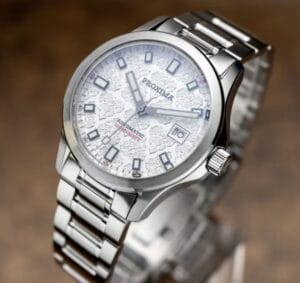

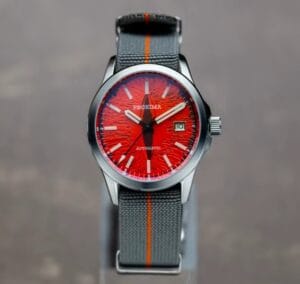
Seagull ST19 (manual-wind chronograph family)
Different category entirely: hand-wound, classic chronograph architecture, enthusiast favourite because it brings mechanical chronograph ownership into reach.
Typical profile:
- 21,600 bph
- low-20s jewel count (varies by version)
- ~40+ hours power reserve
- column-wheel chronograph behaviour depending on variant
Daily wear implication: it’s not a “set and forget” movement. It’s interactive. It’s also thicker and more mechanically involved, because chronographs are mechanically involved.
Seagull ST25 (bigger, more modular family)
ST25 shows up in watches with more complicated displays (big date, moonphase, etc.) and in larger-format cases.
Typical profile:
- 21,600 bph
- power reserve often cited mid-40s hours
- jewel count varies widely because the family supports multiple modules/variants
Daily wear implication: ST25 is often used when the brand wants features and visual complexity at a budget price — but the packaging (thickness and case design) matters as much as the movement itself.
Seagull ST28 (mechanical alarm niche)
This is more of an enthusiast footnote in the budget space: mechanical alarm functionality, very niche, very “because it’s cool” rather than “because it’s practical.”
Miyota automatics: dependable, slightly agricultural, extremely common
Miyota (Citizen Group) movements are the ones I associate with “tool watch behaviour.” They’re not fancy. They’re usually robust. They’re everywhere.
Miyota 8215 (date) / 8205 (day-date)
This is the baseline Miyota family. It’s a true budget workhorse.
Typical profile:
- 21,600 bph
- 21 jewels
- ~42 hours power reserve
- accuracy typically quoted around -20/+40 sec/day
And yes — the “old Miyota” reputation is real: many examples historically didn’t hack. Over time, hacking became more common in newer production runs/variants, and the broader market has pushed for that usability upgrade.
Daily wear implication: they run. They take wear. The rotor can be noisy. The hand-winding feel can be a bit gritty. But you get a movement that behaves like it’s meant to be worn, not admired through a loupe.
Miyota 9015 (premium Miyota lane)
If 8215 is the work truck, 9015 is the “cleaner,” more modern feeling option.
Typical profile:
- 28,800 bph
- 24 jewels
- ~42 hours power reserve
- accuracy is typically quoted tighter than the 82xx family
Daily wear implication: smoother seconds motion, often a more refined setting/winding feel, and commonly used when a brand wants to signal “this is a step up” without going Swiss.

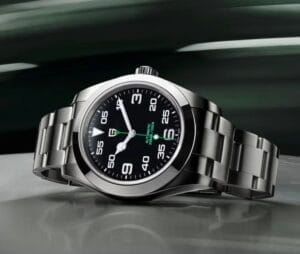
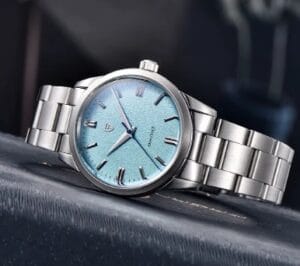
Seiko NH series: the budget automatic default for a reason
The NH family is the backbone of modern budget mechanical watches. Not because it’s the best at any single spec — but because it’s predictable.
Common baseline traits:
- 21,600 bph
- usually 24 jewels
- ~41 hours power reserve
- accuracy commonly quoted in that -20/+40 sec/day band
NH35 / NH36 / NH38 (date / day-date / no-date)
These are your everyday NH options. They’re friendly movements: easy to live with, easy to service, easy to regulate to decent real-world performance.
- NH35 – date
- NH36 – day-date
- NH38 – no date
NH34 (budget GMT)
NH34 brought affordable GMT into the mainstream. It’s not a luxury GMT movement — it’s a practical, accessible one. In daily wear, it’s the kind of movement that makes “complication ownership” viable without needing to baby the watch.
And yes: the Magic Lever winding system is a big part of why these movements behave so well in real life. They build reserve efficiently from normal motion. They’re designed to run.
PT5000: the high-beat clone lane (good when executed well)
PT5000 is the movement you see when brands want to offer:
- a 28,800 bph high-beat spec
- a more “Swiss-like” enthusiast spec sheet
- a more refined feel on paper
When it’s regulated and cased properly, it can feel like a genuine step up in smoothness and perceived precision. When it isn’t, it can feel like a high-beat movement that simply exposes poor execution faster.
Daily wear implication: potentially more refined, but I care more about the brand’s QC here than I do with NH.
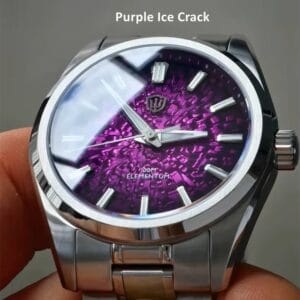
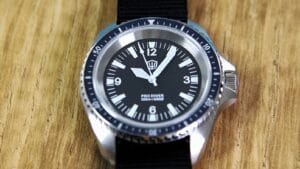
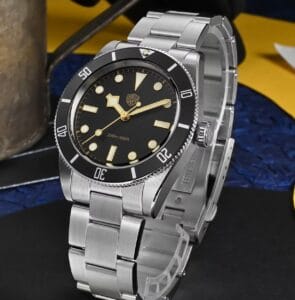
Swiss mechanical: Sellita vs ETA (don’t lump them – think in “tiers”)
If you want to talk about Swiss movements properly, you have to stop treating “Sellita” as one blob. In daily wear, SW200 and SW300 don’t feel the same because they’re built for different roles.
Sellita SW200-1 (the “SW1” most people mean)
This is the mainstream Swiss automatic base movement you’ll see in a huge number of watches.
Typical profile:
- 28,800 bph
- 26 jewels
- ~38–41 hours power reserve
- available in different grades (and grade affects regulation expectations)
Daily wear implication: it tends to feel consistent — winding, setting, stability. It’s a mature, serviceable platform. You’re paying for control, not magic.
Sellita SW300-1 (the “SW2” upgrade lane)
This is thinner, more “2892-style,” and typically positioned as a step up.
Typical profile:
- 28,800 bph
- 25 jewels
- power reserve commonly seen as ~42 hours, with newer optimized versions seen higher depending on build
- thinner architecture than SW200
Daily wear implication: this movement often enables better case proportions. It’s the type of upgrade you notice more in wearing comfort and case elegance than in day-to-day timekeeping.
ETA equivalents (the context)
ETA’s 2824/2892 families sit behind this whole architecture historically. In modern buying, ETA presence can vary by availability and brand strategy — but functionally, this is the same conversation: mainstream workhorse vs thinner “upgrade” lane.
Final Thoughts
At this level, no movement is flawless – but many are honest, durable, and genuinely enjoyable to wear if you know what you’re getting into. Once you stop treating specifications as promises and start viewing them as tendencies, the picture becomes much clearer.
Learn the movements, and the watches start making sense. If you are intent on getting to know the affordable quartz movements as well, I’ve prepared The Affordable Quartz Movements Buying Guide you may want to explore.