Watch Crystals Explained: Sapphire, Mineral, Acrylic — What Actually Matters
When I review a watch, I always talk about the crystal. Not because it sounds technical, but because the crystal is the first structural barrier between the dial and the outside world. It’s the part that takes impact, glare, scratches, pressure, and daily abuse — and yet it’s one of the most misunderstood components in the entire watch.
People often reduce it to a single phrase: “It has sapphire.” As if that ends the discussion.
It doesn’t. Crystal choice affects durability, legibility, thickness, distortion, servicing, water resistance, and even how premium a watch feels. And like most things in watchmaking, the material alone doesn’t tell the whole story. Thickness, treatment, and how it’s mounted matter just as much.
This guide breaks down the major crystal types you’ll encounter — acrylic, mineral, hardened mineral, and sapphire — and explains what they’re really like in daily wear.
What a Watch Crystal Actually Does
At a basic level, the crystal protects the dial and hands from dust, moisture, and impact. But that’s only the surface-level explanation.
The crystal must:
- Resist scratching from daily contact
- Survive shocks and knocks
- Withstand pressure (especially in dive watches)
- Maintain clarity under different lighting conditions
- Seal correctly with the case to preserve water resistance
It’s not just a “window.” It’s a structural and optical component. And that’s where the differences between materials start to matter.
Acrylic (Hesalite, Plexiglass, Plastic)
Acrylic crystals — often called Hesalite or Plexiglass — are essentially hardened plastic. They were widely used in mid-20th century watches, including professional tool watches, because they were inexpensive, lightweight, and extremely impact resistant.
The key word here is impact resistant.
Acrylic doesn’t shatter easily. When it takes a hit, it flexes. It absorbs shock. That’s why it was used historically in tool watches and early dive watches — not because it was scratch resistant, but because it was less likely to crack catastrophically.
In daily wear, acrylic behaves differently from modern materials:
- It scratches easily.
- Those scratches can often be polished out.
- It has a warm, slightly soft optical quality.
- It distorts beautifully at the edges when domed.
That distortion is not a flaw — it’s part of the vintage charm. Light bends more aggressively through acrylic, especially in high-domed configurations.
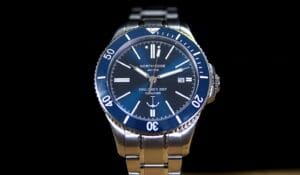
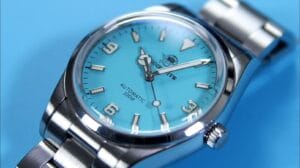
Where You’ll See It Today
- Vintage watches
- Reissues aiming for historical accuracy
- Some budget field or retro divers
Mineral Crystal
Mineral crystal is hardened glass. It sits in the middle of the spectrum — harder than acrylic, softer than sapphire.
This is the material most people encounter in entry-level watches.
It offers:
- Better scratch resistance than acrylic
- Lower cost than sapphire
- Good optical clarity
- Decent impact resistance
But mineral is still glass. And glass scratches.
In daily wear, mineral crystals accumulate micro-scratches over time, especially if you’re hard on your watches. Unlike acrylic, those scratches cannot be polished out easily.
Where Mineral Makes Sense
- Budget everyday watches
- Field watches under heavy cost constraints
- Quartz watches where price efficiency matters
Mineral crystal keeps costs down and performance reasonable. But it’s not aspirational. It’s a compromise solution.
Hardened Mineral (K1, Flame-Fusion, etc.)
This is where things get slightly more nuanced.
Some brands use hardened mineral variants, often marketed under proprietary names. These are chemically or thermally strengthened mineral glasses designed to improve scratch resistance without reaching sapphire cost levels.
Performance-wise, hardened mineral:
- Resists scratches better than standard mineral
- Still doesn’t match sapphire hardness
- Often retains good impact resistance
- Is less expensive than sapphire
In budget watches, hardened mineral can be a smart middle ground. It won’t satisfy someone chasing spec-sheet prestige, but in real life it performs better than people assume.
The key difference between hardened mineral and sapphire isn’t just hardness — it’s long-term scratch behaviour.
Sapphire resists micro-abrasion much better.
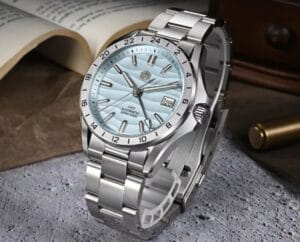
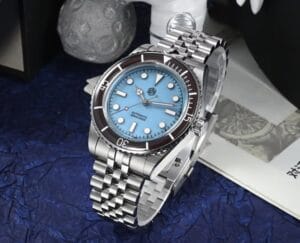
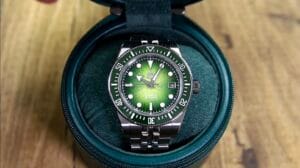
Sapphire Crystal
Sapphire is synthetic corundum. It ranks extremely high on the hardness scale — much harder than mineral or acrylic.
In daily wear, this means:
- It is extremely scratch resistant.
- It maintains clarity for years.
- It feels “premium” because it stays clean-looking.
That’s why sapphire has become the standard in enthusiast watches. But sapphire has its own trade-offs. It is harder, but hardness doesn’t equal indestructibility. Sapphire is more brittle than acrylic. Under sharp impact, it can chip or crack. That’s rare in normal use, but it’s possible.
What matters just as much as the material is the thickness.
Crystal Thickness: The Quiet Structural Factor
Crystal thickness is rarely advertised, but it directly affects:
- Water resistance
- Impact resistance
- Case proportions
- Overall durability
Under pressure — especially underwater — the crystal is subjected to external force trying to push it inward. Even in daily wear, crystals experience micro flex from knocks and temperature changes.
A thicker crystal resists deformation better. Less flex means more consistent gasket compression. That translates to more reliable water resistance over time.
On serious dive watches, the sapphire is often noticeably thicker. Not because it looks impressive, but because it must withstand pressure without flexing excessively. That added thickness increases case height, weight, and manufacturing cost. It is not decorative.
A thin sapphire crystal on a 200m diver is not the same as a thick sapphire crystal on a 200m diver. Under pressure, crystals flex. Thicker crystals resist deformation better. That’s one reason serious dive watches often run thicker domed sapphire — not for aesthetics alone, but for structural integrity.
Thicker crystals:
- Improve pressure resistance
- Increase case height
- Add weight
- Improve rigidity
On slim dress watches, by contrast, crystals are often thinner. They don’t need to manage the same structural load. But if a slim watch advertises high water resistance, I always question how that’s achieved. Either the case is engineered exceptionally well, or compromises have been made elsewhere.
Thickness also affects impact behaviour. A very thin sapphire can chip more easily under a sharp blow. A thicker sapphire distributes force better. The crystal is not floating in space. It’s part of the sealing and structural system. Ignoring thickness is like judging a case by diameter alone without considering lug-to-lug.
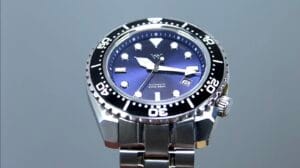
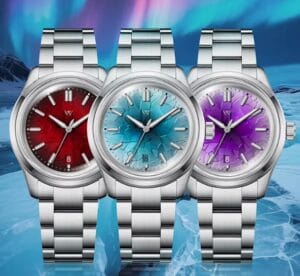
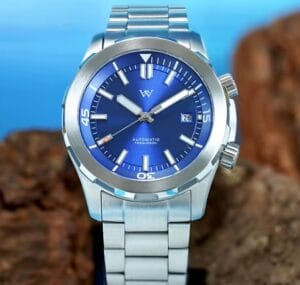
Flat vs Domed vs Box Crystals
Crystal shape is one of those details that most buyers don’t consciously think about — until they start comparing watches side by side. Then it suddenly becomes obvious that the crystal doesn’t just protect the dial. It defines how the watch feels on the wrist and how it interacts with light. Crystal shape affects both aesthetics and performance.
Flat Crystal
- Clean
- Minimal distortion
- Often slimmer
- Modern look
A flat crystal is the most modern and structurally straightforward design. It sits flush with the bezel or slightly above it, with minimal curvature. Visually, it gives the watch a clean, technical, contemporary profile. There’s very little optical distortion when you view the dial from an angle, which makes it ideal for watches prioritising legibility and precision.
Flat sapphire is especially common on dive watches and tool watches, where clarity matters more than nostalgia. Because it doesn’t rise dramatically above the case, it also keeps the overall height in check. That’s important in real wear. A 12mm dive watch with a flat crystal will often feel more compact than a 12mm watch with a tall domed sapphire.
But flat crystals are not automatically superior. They can be highly reflective if anti-reflective coating is minimal, and visually they tend to feel more clinical. If the watch is designed to evoke vintage character, a flat crystal can feel slightly sterile.
Domed Crystal
- Adds vintage character
- Improves pressure distribution
- Increases distortion at angles
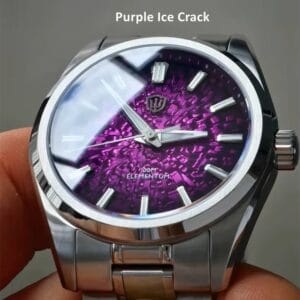
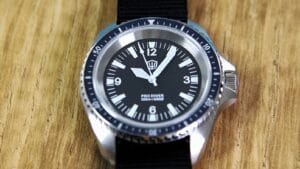
Optically, domed crystals bend light differently. Viewed straight on, they can appear crystal clear. Viewed from an angle, they create edge distortion — sometimes subtle, sometimes dramatic. On vintage-inspired watches, that distortion adds warmth and depth. It makes the dial feel alive rather than flat.
There’s also a structural element. A dome distributes pressure more evenly than a completely flat surface. That’s why historically, domed acrylic crystals were used in professional dive watches. The shape helped manage pressure.
Modern domed sapphire carries forward that aesthetic while adding scratch resistance. But it also increases perceived thickness. Even if the case is technically the same height, the crystal’s curvature makes the watch appear taller. That affects how it slips under cuffs and how it visually balances on the wrist.
A domed crystal is rarely just an aesthetic choice. It signals that the designer is leaning into character over minimalism.
Box Sapphire
- Flat top with vertical edges
- Vintage-inspired
- Taller profile
- More dramatic edge distortion
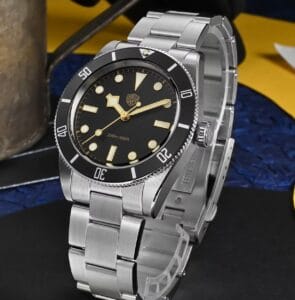
Box sapphire is essentially a hybrid approach. It has a flat top surface but vertical edges, creating a raised profile reminiscent of old acrylic crystals.
This design creates dramatic edge refraction. When you tilt the watch, the dial can warp visually near the perimeter. It’s an intentional nod to mid-century tool watches.
However, box sapphire almost always adds measurable height. That added vertical mass changes the watch’s wrist presence. On smaller case diameters, that can create beautiful vintage proportions. On thicker watches, it can exaggerate bulk.
Domed and box crystals increase case height. That affects wearability. A 12mm watch with a tall box sapphire can wear closer to 13mm visually. These are small design decisions that change the watch’s character entirely.
Anti-Reflective Coating (AR): The Legibility Factor
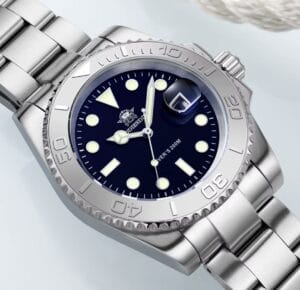
Sapphire’s hardness is one of its greatest strengths — and one of its optical weaknesses. The harder and denser the material, the more light it reflects. It’s very hard — and very reflective. Without anti-reflective (“AR”) coating, sapphire can behave like a mirror.
Without anti-reflective treatment, a sapphire crystal can behave like a mirror. Especially outdoors, especially under bright artificial lighting.
Anti-reflective (AR) coatings are applied in extremely thin layers designed to reduce reflection through light interference. These coatings are not cosmetic films. They are engineered optical treatments. There are typically two approaches:
Underside AR (Most Common)
- Applied to the inside surface only
- Protected from scratches
- Improves legibility
- Often subtle
Most commonly, AR is applied to the underside of the crystal. This protects it from physical abrasion while improving clarity. The effect is noticeable but controlled. You reduce glare without introducing fragility.
Double-Sided AR
- Applied to both inner and outer surfaces
- Dramatically reduces glare
- Can create a “no crystal” effect
- Outer layer can scratch over time
Double-sided AR — coating both inner and outer surfaces — takes clarity further. When executed well, it creates a near “no crystal” effect, where the dial appears directly exposed to air.
But the outer AR layer can scratch. Not the sapphire itself — the coating. Over time, especially in harder use, you may see faint marks on the coating surface. Some brands prioritise maximum legibility and accept this risk. Others prefer longevity over perfection.
The slight blue hue sometimes visible is not decoration. It’s the result of how the coating interacts with certain wavelengths of light. The stronger the coating, the more pronounced that effect can be.
There’s no right answer. It’s a trade-off between optical performance and durability.
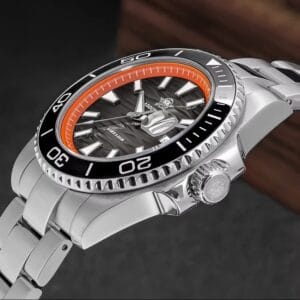
Crystal and Watch Type
Different watch categories prioritise different crystal characteristics.
Dive Watches
- Thick sapphire
- Often flat or slightly domed
- Strong internal AR
- Structural rigidity matters
Field Watches
- Often sapphire or hardened mineral
- Moderate thickness
- Emphasis on clarity and durability
Dress Watches
- Slim profile
- Often flat sapphire
- Less extreme thickness
- Focus on refinement
Vintage Reissues
- Acrylic or box sapphire
- Intentional distortion
- Period-correct styling
The crystal should align with the watch’s purpose. When it doesn’t, it’s usually a cost decision.
Impact Resistance vs Scratch Resistance
This is where buyers get confused.
Harder materials resist scratching better. Softer materials absorb impact better. Hardness and toughness are not the same thing.
Sapphire is extremely hard. That’s why it resists scratching. But hardness can also mean brittleness. Under a sharp, concentrated impact — say, a corner strike against a metal edge — sapphire can chip.
Acrylic, by contrast, is soft but resilient. It scratches easily, but it flexes under impact. It absorbs energy rather than fracturing.
Mineral sits somewhere between the two. In everyday life, most people are more likely to scratch their watch than shatter it. That’s why sapphire dominates the enthusiast space. But in extreme use cases, acrylic historically made sense.
Understanding this distinction prevents oversimplified thinking like “sapphire is always better.” Better for what?
Acrylic
- Scratches easily
- Rarely shatters
Sapphire
- Rarely scratches
- Can chip under sharp impact
Mineral
- Moderate scratch resistance
- Moderate shatter resistance
Which is “better” depends entirely on how you use your watches.
Water Resistance and Crystal Mounting
Water resistance is not just about the material — it’s about how the crystal is seated and sealed. A crystal is not glued in casually. It is compressed into place against a gasket. That compression must be uniform. The machining tolerances of the case and the crystal’s seating surface are critical.
In dive watches especially, the crystal is part of the pressure system. It works together with the caseback and crown assembly. Even the choice between flat and slightly domed can influence how pressure is distributed across the surface. If a brand advertises 200m water resistance but skimps on crystal thickness or mounting precision, the rating becomes less meaningful over time.
The crystal is not separate from the water resistance system. It is one of its primary structural elements.

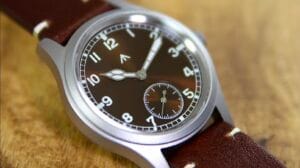
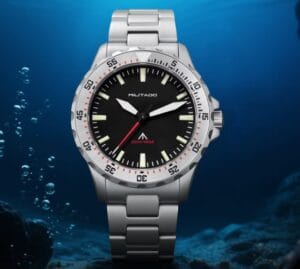
Does Sapphire Always Mean Better?
In the budget segment, sapphire has become a marketing baseline. But not all sapphire crystals are equal.
What matters:
- Thickness
- AR quality
- Surface finishing
- How it integrates with the case
A thin sapphire with no AR can be less legible than a well-executed mineral with internal AR. Material alone doesn’t determine quality. Execution does.
My Take After Reviewing Hundreds of Budget Watches
If I’m evaluating value:
- For daily wear under $100, hardened mineral can be perfectly acceptable.
- Under $300, sapphire should be expected.
- On a diver, thickness and mounting matter more than branding.
- On a dress watch, distortion and profile matter more than impact specs.
The crystal isn’t just a bullet point. It’s part of how the watch feels to own.